Comparison
Koh Samui, Koh Phangan or Koh Tao: which fits your trip
Beaches, villas, parties and dives, compared.

Reviewed

Photo credit
Photo: kallernaCC BY-SA 4.0Wikimedia Commons

- Wettest months
- October to December (Koh Tao: September to November)
- Most villas
- Koh Samui, on our lists as of 17 October 2026
- Ferry route
- Samui to Phangan to Tao
What is the short answer?
As of late 2026, choosing between these three Gulf of Thailand islands comes down to logistics and how you want to spend your days. Pick Koh Samui if you want to fly directly in, rent a villa, and have large supermarkets nearby. Pick Koh Phangan if you want to split your time between big monthly beach parties and quiet yoga centres. Pick Koh Tao if your entire trip revolves around scuba diving and snorkelling. You do not have to choose just one: ferries link all three, though any sailing can be delayed or cancelled in rough seas.
Which suits you
| Koh Samui | Koh Phangan | Koh Tao | |
|---|---|---|---|
| Best for | Direct flights, villas and families | Beach parties or yoga retreats | Diving and snorkelling |
| Feels like | The biggest island: wide roads, malls, resorts | Less developed, with no airport | Small and dive-focused |
| Getting around | Drive the Route 4169 ring road | A scooter, over some steep hills | Walk, or a scooter or taxi boat |
| Nights out | Bars and beach clubs in Chaweng | The monthly Full Moon Party in Haad Rin | Sairee’s bars and fire shows |
How many places we list on each island, from our own lists (the table says when they were counted):
Koh Samui
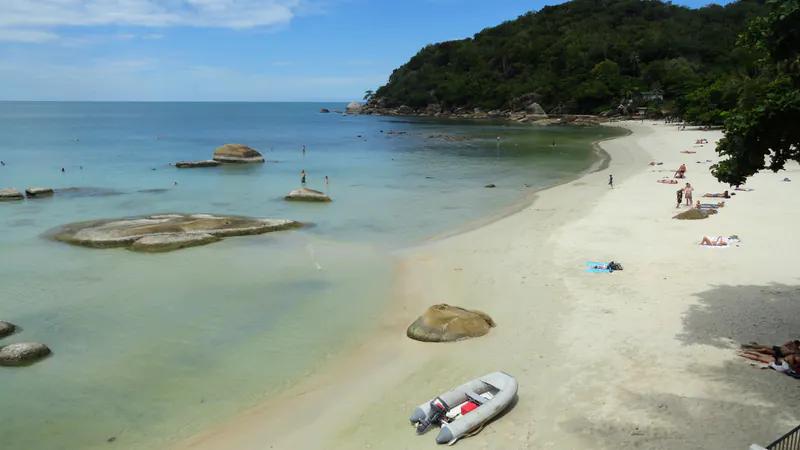
Photo credit
Photo: Fabio Achilli from Milano, ItalyCC BY 2.0Wikimedia Commons

Koh Samui is the largest of the three islands and the only one with its own airport, making it the easiest destination to reach. You get wide roads, large shopping centres, international hospitals and family-focused resorts. Route 4169 is the main ring road circling the coast, which makes it straightforward to drive between towns.
As of 17 October 2026 it had by far the most villas and apartments of the three on our lists (the table above counts them live). Koh Samui Airport is privately owned by Bangkok Airways, meaning flights can be expensive, but they drop you right on the island. Once you land, the drive from the airport to the main tourist hub of Chaweng takes about 15 minutes. If you choose not to fly, you can reach the island by boat, as car ferries from the mainland depart from Donsak pier in Surat Thani and take about 90 minutes to reach Koh Samui.
- Don’t miss
- Chaweng Beach: The longest stretch of sand on the east coast, backed by dense clusters of restaurants and bars.
- Fisherman’s Village: A calmer walking street located in Bophut on the north coast, filled with wooden shophouses.
- Na Muang waterfalls: Twin cascades in the island’s mountainous jungle interior, accessible via a short hike.
- Lamai Beach: A slightly quieter alternative to Chaweng, offering wide sand and a steady rotation of night markets.
- Big Buddha Temple: A prominent gold statue on a small island connected by a causeway, standing 12 metres tall.
- Where to stay
- Choose Chaweng if you want to walk to nightlife and beach clubs, or Bophut if you prefer quiet dinners and boutique shops.
Koh Phangan
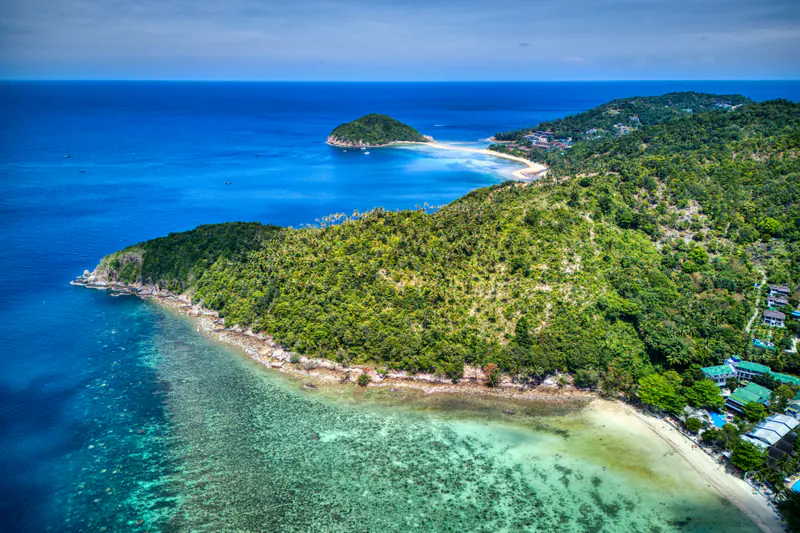
Photo credit
Photo: Hagai Agmon-Snir حچاي اچمون-سنير חגי אגמון-שנירCC BY-SA 4.0Wikimedia Commons

Koh Phangan sits a short ferry ride north of Koh Samui. It has no airport, keeping commercial development lower than its larger neighbour. Ferries arrive at Thong Sala pier, which serves as a central hub for arriving travellers. The island has a split personality: the monthly party in the south, yoga and quiet coves in the west and north.
Getting around requires some caution, as the road from Baan Tai to Haad Rin has some very steep sections, making it dangerous for inexperienced scooter riders.
- Don’t miss
- Haad Rin beach: The southern peninsula where the monthly Full Moon Party takes place, drawing huge crowds for nightlife.
- Sri Thanu: The west coast hub known for yoga and wellness centres, drawing remote workers who settle in for weeks.
- Bottle Beach: A remote northern cove accessible primarily by taxi boat or a steep jungle hike of an hour or more.
- Phantip Market: The central food court in Thong Sala, serving local dishes and grilled meats every evening.
- Salad Beach: A shallow, calm bay on the northwest coast that suits families and casual swimmers.
- Thong Nai Pan: Twin bays in the northeast offering upscale resorts and quiet swimming, far from the party crowds.
- Where to stay
- Choose Sri Thanu for vegan cafes and wellness workshops, or Haad Rin if your trip aligns with the full moon and you plan to stay out late. Our Full Moon Party guide has the expected dates and compares Haad Rin with Thong Sala and Sri Thanu.
Koh Tao
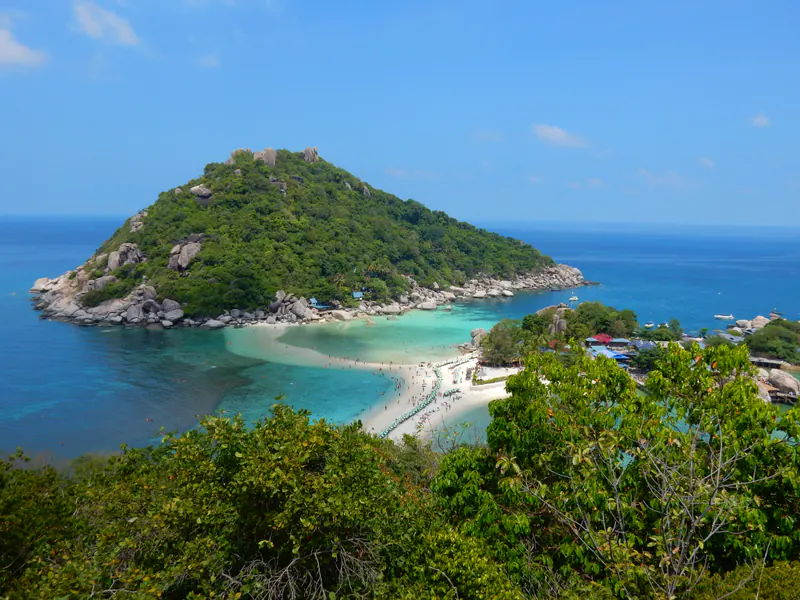
Photo credit
Photo: Roma NeusCC BY 3.0Wikimedia Commons

Koh Tao is the smallest and furthest north of the three islands. The local economy revolves almost entirely around the ocean. The island issues a high volume of PADI and SSI scuba certifications globally, making it a major hub for underwater sports.
Life here concentrates along the west coast, between Mae Haad and Sairee. The island is compact, as Koh Tao covers just 21 square kilometres, and exploring further requires a scooter or a taxi boat. The east-coast bays are reached by steep roads or boats, which keeps the crowds thin, and snorkelling is highly accessible right off the beaches.
- Don’t miss
- Sairee Beach: The main strip for accommodation and nightlife, featuring shallow water and a long pedestrian walking path.
- Shark Bay: A popular snorkelling spot on the south coast to see blacktip reef sharks and sea turtles.
- Koh Nang Yuan: A small island off the northwest coast known for its viewpoint and a sandbar connecting three peaks.
- Tanote Bay: An east coast bay accessed via steep roads, offering deep water for snorkelling right off the beach.
- Mae Haad: The port town where ferries dock, packed with dive gear shops and local cafes.
- John-Suwan Viewpoint: A rocky lookout at the southern tip of the island, accessible via a roughly 20-minute hike.
- Where to stay
- Choose Sairee Beach to be near dive schools and evening fire shows, or Chalok Baan Kao for a quieter, relaxed bay.
How do you hop between them?
You do not have to choose just one island. Ferries run a linear route, leaving Koh Samui, stopping at Koh Phangan and continuing to Koh Tao, then making the return journey south. Timetables change and any sailing can be cancelled for weather, so check the current timetable on the operator’s own site for your date, such as Lomprayah’s current timetable. For getting to the islands from Bangkok by air, rail or bus and boat, see Bangkok to Koh Samui, Koh Phangan and Koh Tao.
- Ferry operators: Lomprayah operates high-speed catamarans, while Seatran operates both conventional ferries and high-speed catamarans.
- Samui departure points: Ferries leave from multiple piers on Koh Samui, including Nathon, Maenam, and Bangrak.
- Travel times: Travel times vary by operator, but the fast ferry from Koh Samui to Koh Phangan takes roughly 30 minutes, while the onward boat from Koh Phangan to Koh Tao takes about 1 to 1½ hours.
- Monsoon disruptions: Ferry schedules often change or face cancellations during heavy storms in the wet season.
- Seasickness: A larger conventional ferry may feel steadier than a fast catamaran, but no boat makes a rough crossing comfortable.
- Pier transfers: Some ferry tickets offer an optional minivan transfer to your hotel for an extra fee, which saves haggling with taxis at the dock; check what yours includes.
Tip
Check directly with the ferry operators for exact schedules, luggage allowances, current fares and what happens if a sailing is cancelled before heading to the pier. Lomprayah’s terms, for example, say fares are non-refundable and timetables can change for weather.
When is the best time to go?
On all three islands the wettest month on average is November, later than on the Andaman coast (September in Phuket and Krabi). The islands still differ: if you are planning a trip later in the year, keep in mind that Koh Samui and Koh Phangan see their heaviest rainfall roughly from October to December, and Koh Tao’s falls roughly from September to November. Storms during these months can disrupt ferry crossings and reduce underwater visibility for divers. If your dates fall in November or December, our guides to where to go in November and December compare the islands with the rest of the country.
For divers, February to April is the drier stretch on average and the popular window to visit, though sea conditions still change from day to day. Koh Samui and Koh Phangan are also relatively dry during the northern hemisphere summer, averaging about 145 to 165 mm a month in July and August, well below Phuket’s 265 to 310 mm; Koh Tao is wetter then (about 225 to 240 mm). July and August see a mini high season for European holidays. These are historical monthly averages, not a forecast: check the Thai Meteorological Department’s 7-day forecast, shipping forecast and weather warnings before you travel.
Frequently asked questions
Which is better, Koh Samui or Koh Phangan?
It depends entirely on your travel style. Koh Samui offers more convenience with its airport, large villas, and family resorts. Koh Phangan requires a ferry ride but rewards you with a less developed coastline, prominent yoga communities, and big beach parties.
Is Koh Tao only for divers?
While the island is famous for scuba certifications, you do not need to dive to enjoy it. Snorkelling is highly accessible right off the beaches, particularly at Shark Bay. The compact size also makes it easy to hike to viewpoints and relax at small beach bars.
Can you visit all three islands in one trip?
Yes. A linear ferry route connects all three islands, so you can start in Koh Samui, hop to Koh Phangan and finish in Koh Tao before taking a boat back. Factor in the travel time, as reaching Koh Tao from Koh Samui takes a large portion of the day, and keep a spare day in the wet season, when sailings can be cancelled.
How do you get to Koh Samui?
The fastest way is flying directly into Koh Samui Airport from Bangkok, Phuket, or Singapore. If you are on a budget, you can fly into Surat Thani Airport on the mainland, take a bus to Donsak pier, and ride the ferry across. This budget route takes most of the day.
When is the rainy season on the Gulf islands?
Koh Samui and Koh Phangan experience their wettest months roughly from October to December, and Koh Tao from September to November; November usually sees the most intense downpours on all three, which can flood roads and halt ferry services. From February to April all three islands are much drier on average (about 36 to 114 mm a month), and Koh Samui and Koh Phangan stay well below their October-to-December totals through August, but that is a historical pattern, not a forecast. Check the Thai Meteorological Department’s weather warnings and shipping forecast before your ferry.
Ready to pick?
Sources and checks
Drafted with help from an AI model, then fact-checked against the sources below and reviewed by Sajal on 17 Oct 2026.
Updated is the last change to what this guide says. Reviewed is when Sajal last checked it.
The numbers in the tables come from our own listings, counted when you open this page.
Sources
- Seatran Ferry: car ferries from Donsak to Koh Samui, about 1 hour 30 minutes, in Thai
- Seatran Discovery: speedboats between Koh Samui, Koh Phangan, Koh Tao and Donsak, in Thai
- The Thaiger: Heavy rains close Gulf ferries, Surin Islands for 2 days (18 Dec 2022)
- Bangkok Airways: Samui International Airport
- Wikipedia: Ko Tao
- Wikipedia: Ko Samui
- Bangkok Airways investor relations: airport business (Samui, Sukhothai and Trat airports)
- Sairee Cottage Diving: How to get to Koh Tao (ferries, flights and trains)
- The Thaiger: Storms cancel ferry service for Koh Samui, Pha Ngan, and Tao (11 Jul 2022)
- Thai Meteorological Department: shipping forecast
- Thai Meteorological Department: 7-day weather forecast
- Thai Meteorological Department: weather warnings
- Lomprayah: terms of service (timetable changes, refunds, missed connections)
- Lomprayah: 2026 timetable
Checked claims
- Koh Samui is the largest of the three islands and the only one with its own airport, making it the easiest destination to reach.
- Koh Samui Airport is privately owned by Bangkok Airways, meaning flights can be expensive, but they drop you right on the island.
- Koh Tao is the smallest and furthest north of the three islands.
- The island is compact, as Koh Tao covers just 21 square kilometres, and exploring further requires a scooter or a taxi boat.
- Ferry schedules often change or face cancellations during heavy storms in the wet season.
- Ferries link all three islands on a linear route; timetables change and any sailing can be delayed or cancelled; check the operator's current timetable.
- No boat makes a rough crossing comfortable; some tickets include a pier transfer, check yours.
- February to April is the drier stretch on average; Koh Samui and Koh Phangan average about 145 to 165 mm a month in July and August, well below Phuket's; Koh Tao is wetter then.
- On all three islands November is the wettest month on average, later than on the Andaman coast (September in Phuket and Krabi); the islands still differ.
- Fast boats between Koh Samui and Koh Phangan take roughly 30 minutes; from Koh Phangan to Koh Tao about 1 to 1½ hours.
- Ferries link the three islands on one line, and leave Koh Samui from Nathon, Maenam (Pralarn) and Bangrak piers.
- Lomprayah runs high-speed catamarans; Seatran runs car ferries and, as Seatran Discovery, speedboats between the islands.
- Car ferries from Donsak pier in Surat Thani take about 90 minutes to reach Koh Samui.
Confirmed: the source supports it; qualified: no source can promise this, so it is worded as something to check. Each check was AI-assisted: “by web search” means a search found the source, “source read” means the source itself was opened and read.
Changes to this guide
First published .
- : Villa count dated and weather wording made specific: the undated count is replaced by our live counts table and a comparison dated 17 October 2026; the weather section now names the wettest month on average (November on all three islands, September in Phuket and Krabi) instead of one shared weather system.
- : Links added beside the reader's next decision: the Koh Phangan stay links the Full Moon Party guide, island hopping links the Bangkok to the Gulf islands guide, and the wet-season months link the November and December guides. No facts changed.
- : Sources made claim-specific: the Tourism Authority of Thailand, Thai Meteorological Department, Lomprayah and Seatran homepages are gone; the TMD forecast pages, Lomprayah's 2026 timetable and terms, and Seatran's ferry and Discovery service pages now back those points, and every source has a real title. Checked against Lomprayah's 2026 timetable on 17 Oct 2026, the Koh Phangan to Koh Tao boat now reads about 1 to 1½ hours. Climate figures now name NASA POWER's dataset (MERRA-2 monthly means, 2001–2020), its temperature and rainfall parameters and each place's coordinates, and link that place's exact data query instead of the NASA POWER homepage.
- : Ferry and weather advice made conditional: ferries can be delayed or cancelled, no calm-sea or mostly-sunny promises; Koh Tao's wettest months given as September to November; links to TMD forecasts and Lomprayah's timetable and terms.
- : New card layout reviewed and published by Sajal.
- : Each point said once: the repeated short-answer bullets and the per-island "Best for", "Pick this if" and "Skip this if" lines are gone, their facts kept in the comparison table and the island text. No new claims.
- : Said once: "Largest island" left the "at a glance" strip (the table says it). No new claims.
- : Rewritten in its own tone; 14 facts checked by web search with sources, 2 still to check by a person.
- : 1 more facts confirmed by web search (sources added); 1 left for a person to check.
- : Reviewed and published by Sajal.
- : Restructured into destination cards from the published version; new claims marked for checking.
- : 10 more facts confirmed by web search (sources added); 5 left for a person to check.
- : 35 more facts confirmed by web search (sources added); 8 left for a person to check.
- : AI-assisted draft; not yet checked.