Month guide
Chiang Mai burning season 2027: checking the air and where else to go
For a February to April trip.

Reviewed Data refreshed

Photo credit
Photo: FredTCCC BY-SA 4.0Wikimedia Commons

- Often worst
- March and April in recent years
- Usually affected
- Chiang Mai, Chiang Rai, Pai
- Southern bases
- Koh Samui, Koh Tao, Krabi, Phuket
- Live readings
- Air4Thai app and website (PCD)
The short answer
This guide describes the pattern of recent years, not a forecast for 2027. In recent years, smoke from crop and forest burning has often pushed the air in Chiang Mai, Chiang Rai and Pai to levels that Thai officials say affect health, usually somewhere between February and April. If your trip falls in those months, keep your plans flexible and check the current reading before you commit.
- Often the worst: March and April. NASA’s Earth Observatory describes these as Chiang Mai’s haziest months, until the May rains clear the smoke.
- Check the air: The Pollution Control Department (PCD) runs the official Air4Thai app and website, with hourly readings from its stations and a 7-day forecast.
- Go south instead: The Gulf islands and the Andaman coast are a long way from the northern fires. That is not a promise of clean air, so check their readings in Air4Thai too.
- If you stay: Follow the official advice for the day’s reading. On a high day in April 2026, PCD’s Chiang Mai office asked people to avoid outdoor activities and, if they had to go out, to wear a PM2.5 mask each time.
March at a glance: weather averages
| Destination | Rain | Temp | VerdictAbout these numbersMarch averages: NASA POWER climatology (MERRA-2, monthly means 2001–2020), air temperature (T2M) and rainfall (PRECTOTCORR) at each place's centre, fetched . Some rain means 100–199 mm; hot means 28 °C or more, or 1 °C above its yearly mean; often smoky: the north in February to April. The data for each place: Chiang Mai, Chiang Rai, Pai, Bangkok, Koh Samui, Koh Phangan, Koh Tao, Krabi, Phuket, Koh Lipe. |
|---|---|---|---|
| Chiang Mai | ~23 mm | 25 °C | Hot, often smoky |
| Chiang Rai | ~26 mm | 25 °C | Cool and dry, often smoky |
| Pai | ~23 mm | 23 °C | Hot, often smoky |
| Bangkok | ~47 mm | 30 °C | Hot |
| Koh Samui | ~114 mm | 28 °C | Some rain |
| Koh Phangan | ~114 mm | 28 °C | Some rain |
| Koh Tao | ~104 mm | 28 °C | Some rain |
| Krabi | ~106 mm | 28 °C | Some rain |
| Phuket | ~112 mm | 28 °C | Some rain |
| Koh Lipe | ~127 mm | 29 °C | Some rain |
These are long-term weather averages, not a forecast and not an air reading. “Often smoky” is our flag for the northern destinations from February to April, not a measurement. For the air on your dates, check Air4Thai.
When and why the air gets bad
In recent years the haze has usually built up through February. Farmers across northern Thailand and neighbouring countries burn crop residue to clear their fields cheaply and quickly for the next planting cycle. Forest fires add heavy, thick smoke to the mix.
Some of these fires occur naturally due to the extremely dry conditions in the forests. Others are lit intentionally to clear thick undergrowth, which makes it easier for locals to forage for valuable wild mushrooms.
Chiang Mai sits in the Ping River valley, and NASA’s Earth Observatory notes that smoke collects in the valleys of the region. It describes March and April as the worst months, until the monsoon rains arrive in May. The timing shifts from year to year: on 19 April 2026, PCD’s Chiang Mai office was still reporting levels that affect health across Chiang Mai, Chiang Rai, Lamphun and Mae Hong Son.
Checking air quality
- Use the official readings: Thailand’s Pollution Control Department publishes its readings in the Air4Thai app and on its website, from monitoring stations across the country, updated hourly.
- Don’t mix scales: The Thai AQI is not the US AQI that many international apps show, so the same air can get a different number. Read a number only against the category and advice the same app gives beside it.
- Know what is measured: The readings track PM2.5, dust particles smaller than 2.5 microns.
- Check before you go out: Readings change from day to day. Air4Thai’s 7-day forecast helps you plan, and the current reading tells you about today.
If you are in Chiang Mai anyway
The advice below follows PCD’s Chiang Mai notice of 19 April 2026, issued on a day when its readings were at levels that affect health. Check the current notice and reading for the days you are there.
- Cut outdoor time: Avoid outdoor activities, and limit hard exercise outside. On days like that, hikes and cycling up the mountain roads are best left for later.
- Mask up when you go out: If you have to go outside, wear a mask made for PM2.5 each time.
- Watch for symptoms: Look out for coughing, difficulty breathing or irritated eyes, and see a doctor promptly if they appear. People with a chronic illness, children and older people should take extra care.
- Bring what you need: Have your medicines with you, and follow your doctor’s advice.
- Ask your stay: Before booking, ask whether your room has its own air purifier and windows that close properly. Not all properties have them.
- Cafes and coworking spaces: Whether a venue filters its air varies from place to place. Ask before you settle in for a day’s work, and don’t assume that indoors is cleaner than outside.
Koh Samui
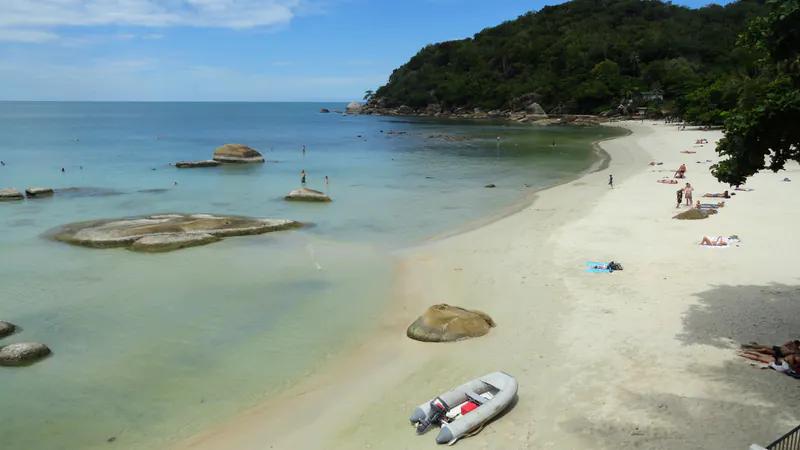
Photo credit
Photo: Fabio Achilli from Milano, ItalyCC BY 2.0Wikimedia Commons

Climate source
Monthly averages from NASA POWER climatology (MERRA-2, monthly means 2001–2020), air temperature (T2M) and rainfall (PRECTOTCORR) at Koh Samui's centre (9.5120° N, 100.0136° E). An average, never a forecast.
Koh Samui sits in the Gulf of Thailand, a long way from the northern burning. March brings short showers and warm weather. Check the nearest Air4Thai station for your dates too.
- Options for your time here
- Fisherman’s Village: Walk through the Friday night market for street food and local crafts at Bophut beach.
- Na Muang waterfalls: Swim in the natural jungle pools after a short hike.
- Ang Thong Marine Park: Take a speedboat tour through this archipelago of 42 limestone islands. The Department of National Parks’ 2026 annual notice lists a scheduled closure from 1 November to 15 December. That schedule does not establish whether a particular March trip operated. Check the latest park notice and your operator’s confirmation for the day you plan to visit, including any 2027 trip. Our national park closures guide lists the 2026 dates.
- Chaweng Beach: Swim in the clear water along the island’s longest, widest stretch of white sand.
- Where to stay
- Pick Bophut for quiet cafes and boutique shops, or Chaweng for nightlife and beach clubs. To choose between the Gulf islands, see Koh Samui, Koh Phangan or Koh Tao.
Our Koh Samui list had 366 villas and apartments as of 17 October 2026. Use that list to compare areas and room details; a large choice of listings does not tell you whether a particular room has filtered air.
Koh Tao
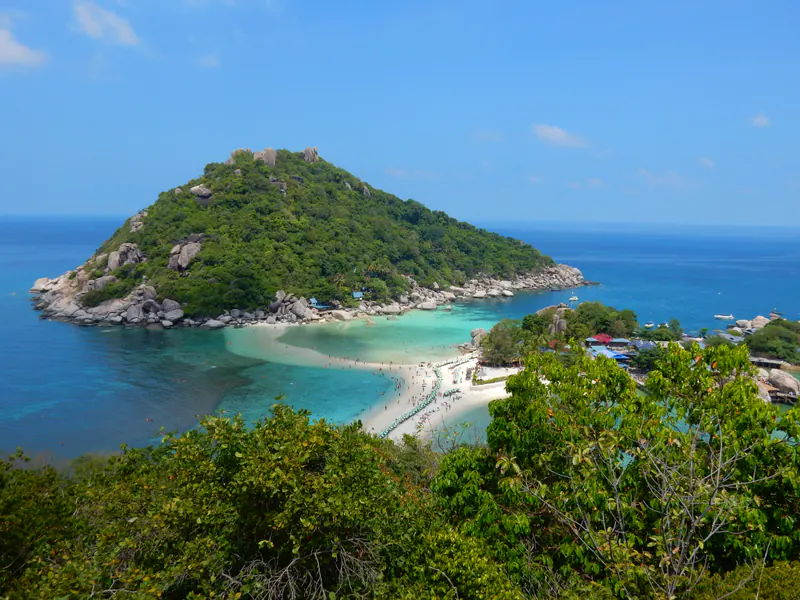
Photo credit
Photo: Roma NeusCC BY 3.0Wikimedia Commons

Climate source
Monthly averages from NASA POWER climatology (MERRA-2, monthly means 2001–2020), air temperature (T2M) and rainfall (PRECTOTCORR) at Koh Tao's centre (10.0956° N, 99.8340° E). An average, never a forecast.
This much smaller Gulf island focuses heavily on underwater activities and marine conservation. It is also far from the northern fires, but check the nearest Air4Thai reading rather than assuming the air is clean. Sea conditions in March vary from day to day, so check the Thai Meteorological Department’s shipping forecast before a boat day. The wettest months here are roughly September to November; on average February is the driest month (about 36 mm), and March and April average about 105 mm.
- Options for your time here
- Sairee Beach: Watch the sunset from the beachfront bars along the island’s main commercial strip.
- Shark Bay: Snorkel in the shallow waters to spot blacktip reef sharks commonly seen year-round.
- Koh Nang Yuan: Take a longtail boat to this connected trio of islands open daily with a small entrance fee.
- John-Suwan Viewpoint: Climb the rocky trail at the southern tip taking about 20 minutes for a view of two curved bays.
- Where to stay
- Pick Sairee Beach for diving schools and nightlife, or Chalok Baan Kao for a quieter, relaxed bay.
Koh Tao makes most sense if diving or snorkelling is central to the trip. Allow for the boat transfer; choose a different base if quick airport access matters more.
Krabi
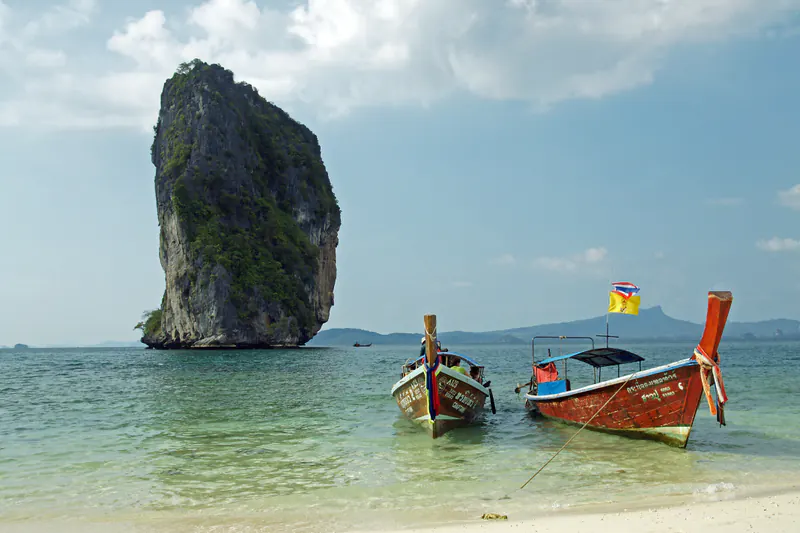
Photo credit
Photo: kallernaCC BY-SA 3.0Wikimedia Commons

Climate source
Monthly averages from NASA POWER climatology (MERRA-2, monthly means 2001–2020), air temperature (T2M) and rainfall (PRECTOTCORR) at Krabi's centre (8.0412° N, 98.8259° E). An average, never a forecast.
Krabi offers dramatic limestone cliffs and easy access to mainland beaches along the Andaman coast. It sees some showers in March, and it is a long way from the northern burning. Check the nearest reading before you go.
- Options for your time here
- Railay Beach: Take a longtail boat to this peninsula cut off from the mainland by towering cliffs.
- Tiger Cave Temple: Climb the steep stairs to a mountain summit consisting of 1,260 steps featuring a large golden Buddha.
- Khao Khanab Nam: Hire a boat from Krabi Town to see the two limestone hills rising from the river.
- Ao Nang night market: Eat fresh seafood and southern Thai curries at the evening food stalls operating daily.
- Where to stay
- Pick Ao Nang for easy access to island-hopping boats and restaurants, or Krabi Town for a more local, residential feel. To weigh Krabi against Phuket, see Phuket or Krabi.
Choose your Krabi base around the trips you want to take. Ao Nang, Railay and Krabi Town serve different plans, so check the transfers before treating them as interchangeable.
Phuket
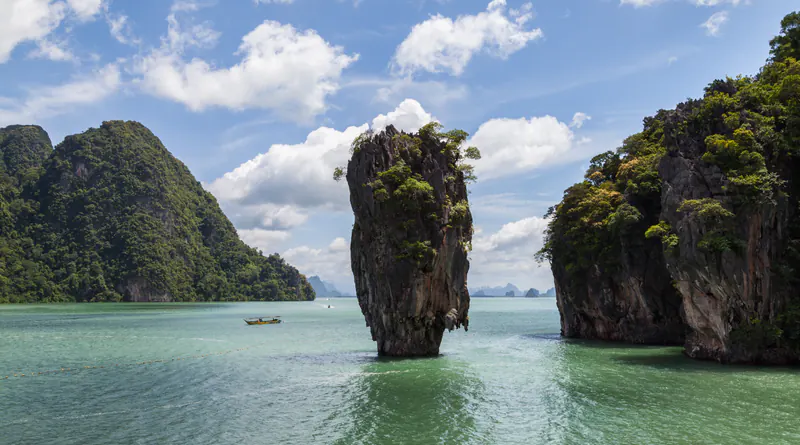
Photo credit
Photo: Diego DelsoCC BY-SA 3.0Wikimedia Commons

Climate source
Monthly averages from NASA POWER climatology (MERRA-2, monthly means 2001–2020), air temperature (T2M) and rainfall (PRECTOTCORR) at Phuket's centre (7.8804° N, 98.3381° E). An average, never a forecast.
Thailand’s largest island sits on the Andaman coast and has a wide spread of beaches, towns, and infrastructure. The March weather is hot with occasional showers, and the island is far from the northern fires. Its air still varies, so check the nearest Air4Thai station for your dates.
- Options for your time here
- Old Phuket Town: Walk past the restored Sino-Portuguese shop houses and historic cafes.
- Big Buddha: Drive up the Nakkerd Hills for panoramic views of the southern coastline from the 45-meter tall statue.
- Kata Noi Beach: Swim at this smaller, quieter bay located just south of the main tourist centers.
- Phang Nga Bay: Book a boat tour to see the sheer limestone karsts rising straight out of the green water.
- Where to stay
- Pick Phuket Town for culture and cafe-hopping, or Kata for a wide, sandy beach with calm water.
Phuket offers an international airport and a wide choice of villas and apartments (536 on our list as of 17 October 2026). Choose the area carefully: getting between the town and beaches takes time in traffic.
Frequently asked questions
When is the burning season in Chiang Mai?
In recent years it has usually run from around February until the rains arrive in May, with March and April often the worst. The timing and severity change from year to year, so check the current reading in Air4Thai close to your trip.
Is it safe to visit Chiang Mai in March?
It depends on the day’s reading and on your health. In recent years March and April have often been the smokiest months, and on bad days readings reach levels that PCD classes as affecting health. Check Air4Thai before you book and while you are there, and follow PCD’s advice for the day: on high days it asks people to avoid outdoor activities and to wear a PM2.5 mask when they go out. If you have a chronic illness, or you are travelling with children or older relatives, ask your doctor before you go.
Where should I go in Thailand in March?
The Gulf of Thailand islands like Koh Samui and Koh Tao, or Andaman coast destinations like Krabi and Phuket, are a long way from the northern fires. In March they average about 100–130 mm of rain (see the table above). Distance is not a guarantee of clean air, so check the Air4Thai reading for wherever you are heading.
Does the smoke reach Bangkok?
Bangkok is far from the northern valleys where the smoke collects, but the capital has its own air pollution. Check its Air4Thai reading too rather than assuming the air is clean.
Ready to pick?
Sources and checks
Drafted with help from an AI model, then fact-checked against the sources below and reviewed by Sajal on 19 Oct 2026.
Updated is the last change to what this guide says. Reviewed is when Sajal last checked it. Data refreshed is when the weather averages or the dated facts it shows were last fetched or checked.
Sources
- Pollution Control Department, Air4Thai: about the air quality index (Thai AQI levels and advice), in Thai
- PCD Office 1 (Chiang Mai): air quality above the standard, notice of 19 April 2026
- IQAir: Chiang Mai among the top 10 most polluted cities during Thailand's burning season (4 Mar 2026)
- Koh Nangyuan Resort: how to get to Koh Nangyuan Island (day visits and entrance fee)
- Wikipedia: Phuket Big Buddha
- PCD Office 14: the Air4Thai app (10 August 2026)
- NASA Earth Observatory: hazy skies in Chiang Mai (8 April 2024)
- U.S. Embassy & Consulate in Thailand: Air Quality Index (AQI), on how Thailand's AQI differs from the U.S. EPA AQI
- Wikipedia: Ko Samui
- Wikipedia: Railay Beach
- IQAir: Chiang Mai air quality map (live readings on the US AQI)
- IQAir: New data exposes Thailand's 2021 'burning season' (17 May 2021)
- Royal Gazette: Department of National Parks notice closing national parks and forest parks to tourism and overnight stays in 2026 (published 9 Jan 2026), in Thai
- IQAir: When air quality is 'Unhealthy for Sensitive Groups' (7 Jan 2026; the US AQI)
- Thai Meteorological Department: shipping forecast
Dates
- Mu Ko Ang Thong closed to visitors and overnight stays: 1 Nov – 15 Dec 2026
Confirmed: announced by the source.
Checked claims
- The readings track PM2.5, dust particles smaller than 2.5 microns.
- Railay Beach: Take a longtail boat to this peninsula cut off from the mainland by towering cliffs.
- Big Buddha: Drive up the Nakkerd Hills for panoramic views of the southern coastline from the 45-meter tall statue.
- This guide describes the pattern of recent years, not a forecast for 2027. In recent years, smoke from crop and forest burning has often pushed the air in Chiang Mai, Chiang Rai and Pai to levels that Thai officials say affect health, usually somewhere between February and April.
- NASA's Earth Observatory describes March and April as Chiang Mai's haziest months, until the monsoon rains arrive in May.
- On 19 April 2026 PCD's Chiang Mai office was still reporting levels that affect health across Chiang Mai, Chiang Rai, Lamphun and Mae Hong Son.
- Air4Thai has a 7-day air quality forecast.
- PCD's advice on a high day (19 April 2026): avoid outdoor activities; if you must go out, wear a PM2.5 mask each time; limit strenuous outdoor exercise; watch for coughing, difficulty breathing or eye irritation and see a doctor promptly; people with chronic illness, children and older people take extra care; have medicines ready and follow your doctor's advice.
- The Thai AQI is not the US AQI that many international apps show; read a number against the category and advice the same app gives.
- Koh Nang Yuan is open daily to day visitors, with an entrance fee.
Confirmed: the source supports it. Each check was AI-assisted: “by web search” means a search found the source, “source read” means the source itself was opened and read.
Changes to this guide
First published .
- : Clarified that the Ang Thong annual closure schedule does not establish a particular March opening; tightened the choice of southern bases.
- : Villa counts dated: the Koh Samui and Phuket counts now say what they count and when: villas and apartments on our lists as of 17 October 2026 (366 and 536).
- : Links added beside the reader's next decision: the Ang Thong note links the national park closures guide, and the Koh Samui and Krabi stays link the Gulf island comparison and Phuket or Krabi. No facts changed.
- : Sources made claim-specific: the Air4Thai, TMD and IQAir homepages are gone; Air4Thai now links its official AQI page (the Thai categories and advice), the TMD shipping forecast stays, and duplicate IQAir pages and an unrelated Phi Phi shark factsheet are removed. Every other source has a real title in place of its domain. No facts changed. Climate figures now name NASA POWER's dataset (MERRA-2 monthly means, 2001–2020), its temperature and rainfall parameters and each place's coordinates, and link that place's exact data query instead of the NASA POWER homepage.
- : Air and health advice rewritten: seasonal timing given as the pattern of recent years, protection advice attributed to PCD's 19 April 2026 notice, no clean-air promise for southern bases, rooms or cafes, and the Thai AQI threshold removed until the official table is checked. Ang Thong's March opening is now dated to the Department of National Parks' 2026 notice.
- : Koh Tao sea and rain sentences made conditional: March sea conditions vary, February the driest month on average, wettest months September to November; link to TMD's shipping forecast.
- : New card layout reviewed and published by Sajal.
- : Rewritten in its own tone; 4 facts checked by web search with sources, 2 still to check by a person.
- : 0 more facts confirmed by web search (sources added); 2 left for a person to check.
- : Reviewed and published by Sajal.
- : Restructured into destination cards from the published version; new claims marked for checking.
- : 6 more facts confirmed by web search (sources added); 3 left for a person to check.
- : 31 more facts confirmed by web search (sources added); 10 left for a person to check.
- : AI-assisted draft; not yet checked.